


Edge InspectiON
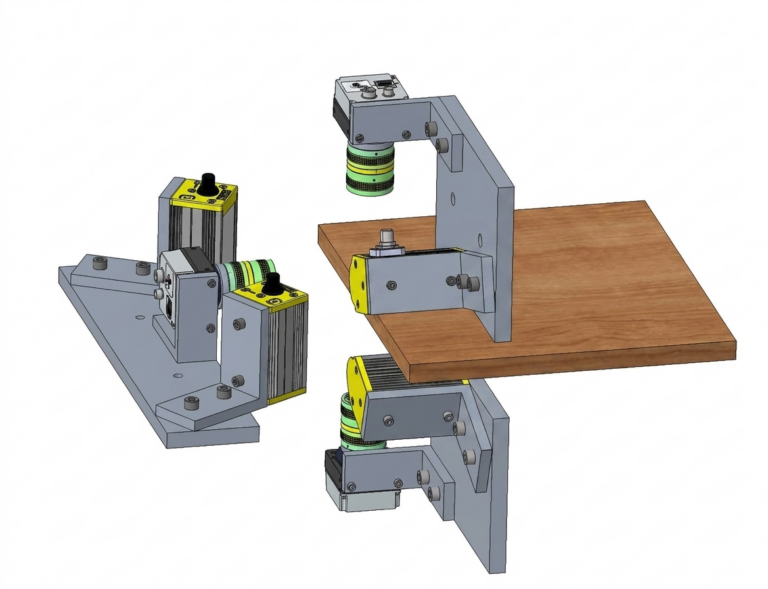
Fully automated defect detection and classification for the timely identification of flaws
AI-powered machine vision solutions for complex quality requirements
Detection of all relevant edge defects – regardless of whether they cause a geometric change
Prevention of false detections to boost product quality and competitiveness
AI-supported quality control for furniture edges
For the quality control of a furniture edge, what matters is whether a relevant defect is present—not whether that defect causes a measurable geometric change.
Edge InspectiON therefore directly inspects the visible appearance of the edge. The system detects chip-outs, open glue joints, overhangs, underhangs, short or missing edge bands, pressure marks, damages, contamination, and other typical edge defects.
A key advantage of vision-based inspection: surface defects, such as damaged decor or surface foils, can also be detected even if they do not cause a relevant change in the component’s geometry.
Through AI-based image processing, various decors and surfaces can be reliably evaluated and false alarms are minimized.
You are currently viewing a placeholder content from YouTube. To access the actual content, click the button below. Please note that doing so will share data with third-party providers.
More InformationFunctions
- Automatic detection and classification of typical defects on furniture edges, including:
- Chip-outs and flaking
- Open glue joints / improperly bonded edges
- Edge overhangs
- Edge bands that are too short or too long
- Completely missing edge bands
- Pressure marks
- Chatter marks
- Dents
- Damage / surface imperfections
- Wrinkles / creasing
- Adhesive residues
- Contamination / dirt
- Surface and decor damage
- Flexible capture and inspection of any variety of decors, colors, and surfaces
- Continuous inline inspection and data processing directly within the production process
Application images
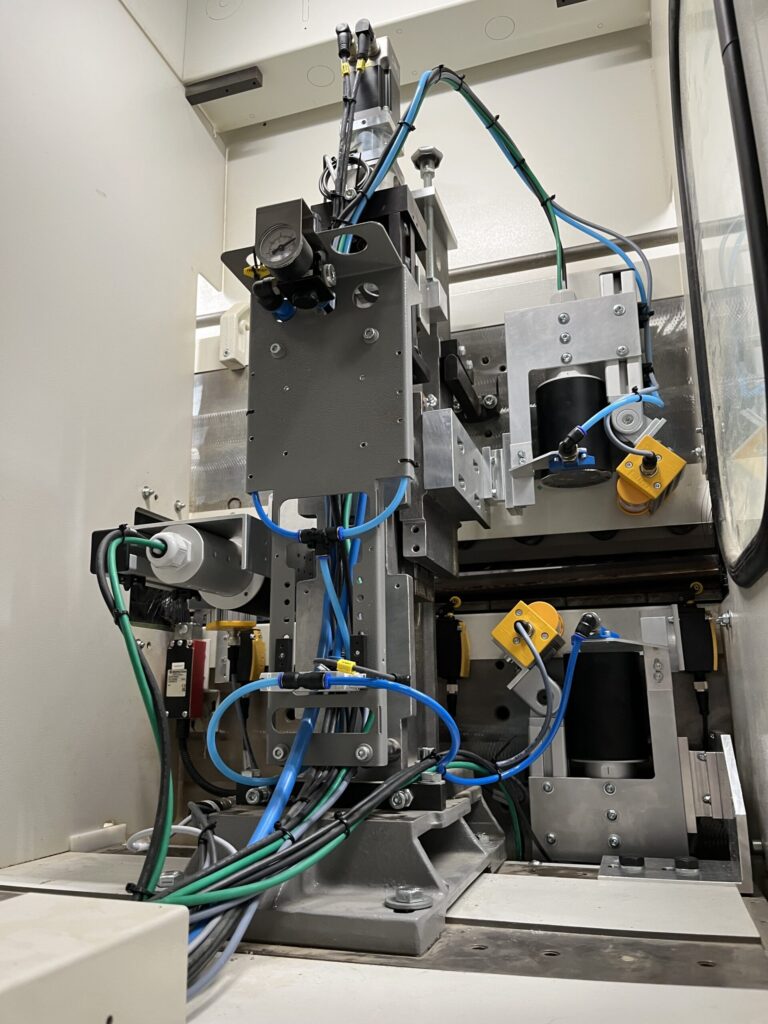
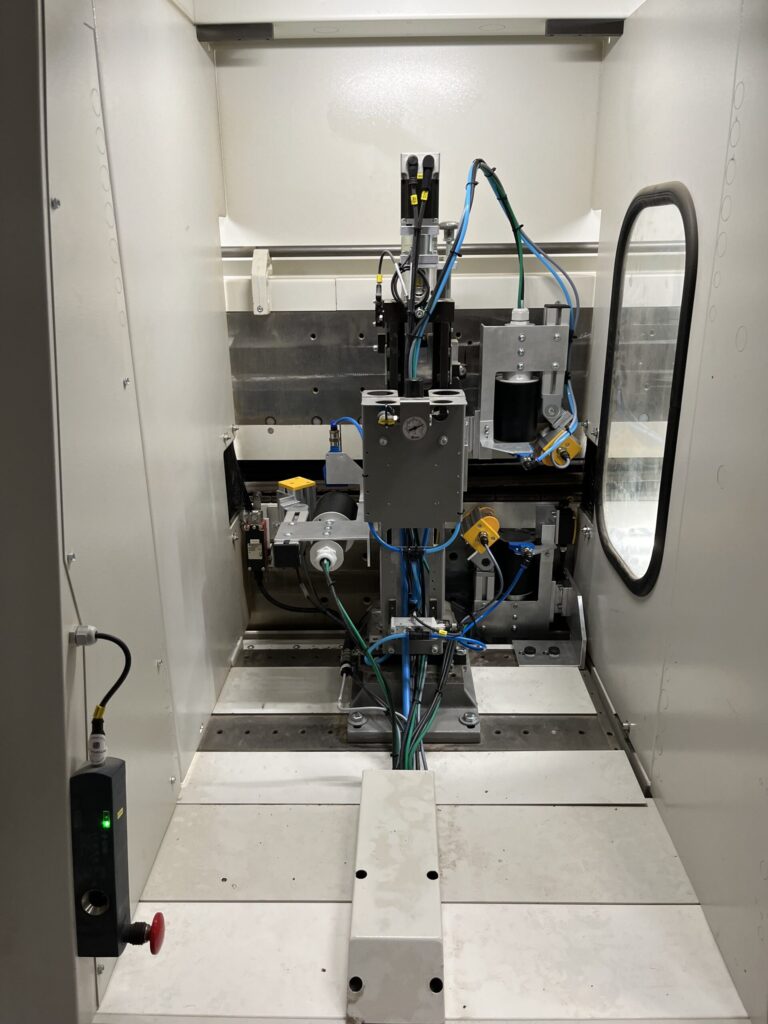
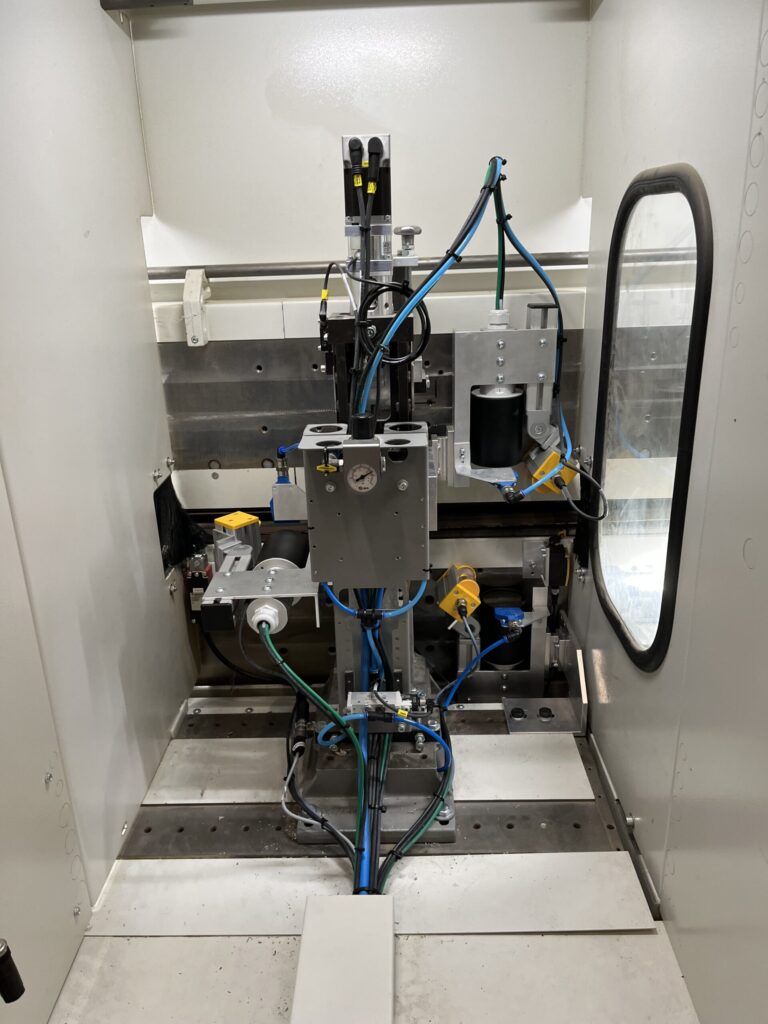
Software-options
- Module for customer- and decor-specific inspection profiles
- Customized interface and data integration (ERP/MES)
- Logging and dashboard for defect analysis in the production process
- Integration of AI and machine vision algorithms
- Data archiving
Advantages
Comprehensive Defect
Detection Detect all relevant furniture edge defects with a single inspection system.
Fewer False Alarms
AI reliably distinguishes actual defects from acceptable decor and surface textures.
100% Inline Inspection
Every component is inspected directly within the production cycle and evaluated with repeatable accuracy.
Edge InspectiON
Edge InspectiON detects typical quality defects on furniture edges, such as chip-outs and flaking, open glue joints, overhangs and underhangs, edge bands that are too short or too long, completely missing edge bands, pressure marks, chatter marks, dents, wrinkles, adhesive residues, contamination, as well as damage to the edge and decor surface.
The respective relevant defect classes can be defined and evaluated according to the specific application and customer-specific quality requirements.
A dedicated inspection neural network is trained for each decor. This enables Edge InspectiON to learn the typical appearance and allowable structures of the respective decor and precisely detect deviations.
This decor-specific approach requires a higher initial setup effort compared to purely geometric 3D inspection. However, it forms the foundation for a vastly more comprehensive quality assessment: Edge InspectiON evaluates not only shape or height deviations, but the actual visible appearance of the furniture edge.
As a result, defects such as chip-outs, open glue joints, overhangs, underhangs, pressure marks, or damages can be detected alongside surface or decor foil imperfections—even when they do not cause a relevant geometric change in the component.
Especially across varying colors, decors, and surfaces, this AI-based evaluation delivers reliable quality control tailored specifically to the given application.
Yes, the system is designed for integration into the edgebander. Generally, an available space of approximately 400 mm width within the line is sufficient.
In edge inspection, the key factor is not the measurement principle itself, but which relevant defects are reliably detected.
3D systems capture the geometry or height profile of the edge. Defects such as chip-outs or overhangs can be detected if they produce a corresponding geometric change.
Edge InspectiON, on the other hand, directly evaluates the visible appearance of the edge. This makes it possible to detect both typical edge defects—such as chip-outs, open glue joints, or overhangs—and defects that do not cause any relevant geometric change, such as damage to the surface or decor foil.
The additional AI-based evaluation allows the system to distinguish complex decors and permissible surface textures from actual defects, thereby reducing false alarms.
For new decors, images are captured and processed through an automated training procedure. Only defect-free parts are used for training. During the production process, defects are then detected as deviations from this trained nominal state. Typically, a dataset of approximately 20 to 30 images is sufficient.
For structured or patterned decors, 40 meters of defect-free edge are required as a training dataset.
This data does not need to be produced separately. Edge InspectiON automatically captures the images during normal production and saves them under the respective decor. Once a sufficient edge length has been processed, training can be initiated.
For solid-colored or highly uniform decors, significantly less image data is typically required, as the surface structure is much simpler.
As a result, the training dataset is generated effortlessly alongside the active production process.
Does the teach-in process work with batch size 1?
Yes. The required image data does not need to be captured within a single, continuous production batch.
Edge InspectiON automatically stores the captured edge images sorted by decor. The required edge length can therefore be collected across multiple orders and production runs.
This makes the system ideal for high-mix production environments and batch size 1 operations.
Yes. The required image data does not need to be captured within a single, continuous production batch.
Edge InspectiON automatically stores the captured edge images sorted by decor. The required edge length can therefore be collected across multiple orders and production runs.
This makes the system ideal for high-mix production environments and batch size 1 operations.
Once sufficient image data is available, the training simply needs to be initiated once in the software. The actual training takes about 12 hours and runs automatically in the background.
Alternatively, HECHT can handle the training as a service. In this case, the new network model is typically available within less than 48 hours after transferring the required image data.
There is no need to program inspection parameters or manually teach individual defect types.
No. Training a new decor does not require any defect images.
Edge InspectiON uses defect-free edges to learn the baseline appearance of each decor. Any deviations from this standard are then detected and evaluated against your defined quality limits.
Consequently, a database of previously known defects is not required.
Alternatively, HECHT can handle the training as a service. In this case, the new network model is typically available within less than 48 hours after transferring the required image data.
There is no need to program inspection parameters or manually teach individual defect types.
No. The appropriate inspection method depends on the specific decor.
For structured, patterned, or visually demanding decors, AI-based vision systems offer distinct advantages because they learn the typical structure of the decor and distinguish it from actual defects.
For solid-colored or highly uniform edges, conventional vision technology already delivers excellent results. In these cases, AI training is not required.
HECHT does not strictly rely on a single technology, but rather applies the method that makes the most sense for each specific inspection task.
Conventional machine vision is exceptionally well suited for clearly defined and uniform features. For solid-colored decors or simple structures, it delivers highly reliable inspection results.
However, with patterned and textured decors, traditional rule-based inspection quickly becomes complex because acceptable decor structures must be differentiated from actual defects.
This is where AI-based inspection offers a decisive advantage: it learns the baseline appearance of the decor, enabling it to evaluate complex structures far more effectively.
Edge InspectiON therefore combines conventional machine vision and AI, deploying each technology where its strengths lie best.
Edge InspectiON evaluates not just individual geometric features, but the actual visible appearance of the edge.
For textured decors, the system must learn which color gradients and patterns belong to the normal surface. Through this teach-in process, Edge InspectiON reliably distinguishes intentional decor structures from actual quality deviations.
For simple or solid-colored decors, this setup effort is reduced accordingly—or can be omitted entirely by using conventional machine vision.
Edge InspectiON operates at an image resolution of over 200 DPI (approx. 8 pixels per millimeter), allowing it to capture extremely small anomalies down to a technical minimum defect size of 0.016 mm².
However, for industrial applications, the key factor is not the theoretical minimum defect size, but identifying which deviations are genuinely relevant to product quality.
A practical baseline for production is approximately 1 mm². This benchmark is based on operational data from more than 20 installed HECHT 4i inline scanners using the same core AI technology across leading manufacturers in the kitchen, office, and home furniture industries.
The allowable defect threshold can be configured individually for each decor to match customer-specific quality requirements.
Yes. Quality thresholds can be set according to the specific requirements of the product and decor.
For example, you can define the exact size threshold at which a detected anomaly is classified as an actual defect.
This ensures that the inspection system does not generically decide what is "good" or "bad." The customer defines their own quality standard—Edge InspectiON enforces it reproducibly.
Edge images are captured during normal production and automatically saved by decor. For textured decors, sufficient data is typically available after processing roughly 40 meters of defect-free edge. For simple, solid-colored decors, significantly less data is required—or conventional machine vision can be used instead.
The training process is launched once and subsequently runs automatically in the background.
This allows Edge InspectiON to combine deep inspection capabilities with manageable setup effort, even across high product variety.
Technical data
- Operation | Control | OS: PC control | Linux or Windows
- Panel Thickness: 5 mm – 60 mm
- Feed Speed: Up to 60 m/min
- Design: Modular setup with 1–3 cameras (top, bottom, narrow side) based on customer requirements
- Installation Width: Approx. 400 mm
- Option: Height adjustment for the top camera (if no built-in height adjustment is present
- Production Capability: Suitable for batch size 1 and series production
- Part Evaluation: Pass / Fail (OK / NOK evaluation)
- Defect Mapping: Display of defect position
- Traceability: Image archiving for post-process traceability
- System Integration: Interfaces to machine control
- Connectivity: MES / ERP integration supported
- Inspection Zones: Top side / Bottom side / Narrow edge
- Line Integration: 100% inline inspection
Comparison of Inspection Principles
| Feature / Defect Type | Camera-Based AI Inspection | 3D Inspection |
|---|---|---|
| Detect chip-outs / tear-outs | ✓ | ✓ |
| Detect short edgebands | ✓ | ✓ |
| Detect long edgebands / overhangs | ✓ | ✓ |
| Detect open glue joints | ✓ | ✓ (if geometrically distinct enough) |
| Detect missing edgebands | ✓ | ✓ |
| Detect pressure marks / physical damage | ✓ | ✓ |
| Detect creases / wrinkles in edgeband | ✓ | Partial (if geometrically detectable) |
| Detect glue residue | ✓ | Partial (if geometrically detectable) |
| Detect contamination / dirt | ✓ | ✕ (or only with geometric variation) |
| Detect surface foil damage | ✓ | ✕ (if no geometric variation occurs) |
| Detect decor and color defects | ✓ | ✕ |
| Detect purely visual surface defects | ✓ | ✕ |
| Detect defects without significant geometric variation | ✓ | ✕ |
| Evaluate actual visible appearance of the edge | ✓ | ✕ |
| Decor-independent operation without decor-specific training | ✕ | ✓ |
| Decor-specific quality evaluation | ✓ | Not required / Not possible based on decor pattern |
| Capture 3D height profile of the edge | ✕ | ✓ |
| Geometric measurement of edge profile | ✕ | ✓ |
Classification & Context
Both inspection principles can identify many typical defects on a furniture edge. The key difference lies primarily in the type of data used for detection.
A 3D system evaluates the geometric shape and height profile of the edge. Consequently, defects like chip-outs, overhangs, or open glue joints are detected as long as they create a sufficiently distinct geometric variation.
In contrast, camera-based inspection like Edge InspectiON evaluates the actual visible appearance of the edge. This enables it to detect the same typical edge defects while also capturing flaws that cause no significant geometric change—such as surface or decor foil damage, color deviations, or dirt and contamination.
While this approach requires more decor-specific training effort than a pure 3D inspection, it is precisely this training that enables a highly differentiated evaluation of the actual visible edge quality.
Use our service.
Phone: +49 (0)7143-8159-0
Ottmarsheimer Hoehe
Heinrich-Hertz-Str. 3-5
74354 Besigheim
You are currently viewing a placeholder content from Google Maps. To access the actual content, click the button below. Please note that doing so will share data with third-party providers.
More Information